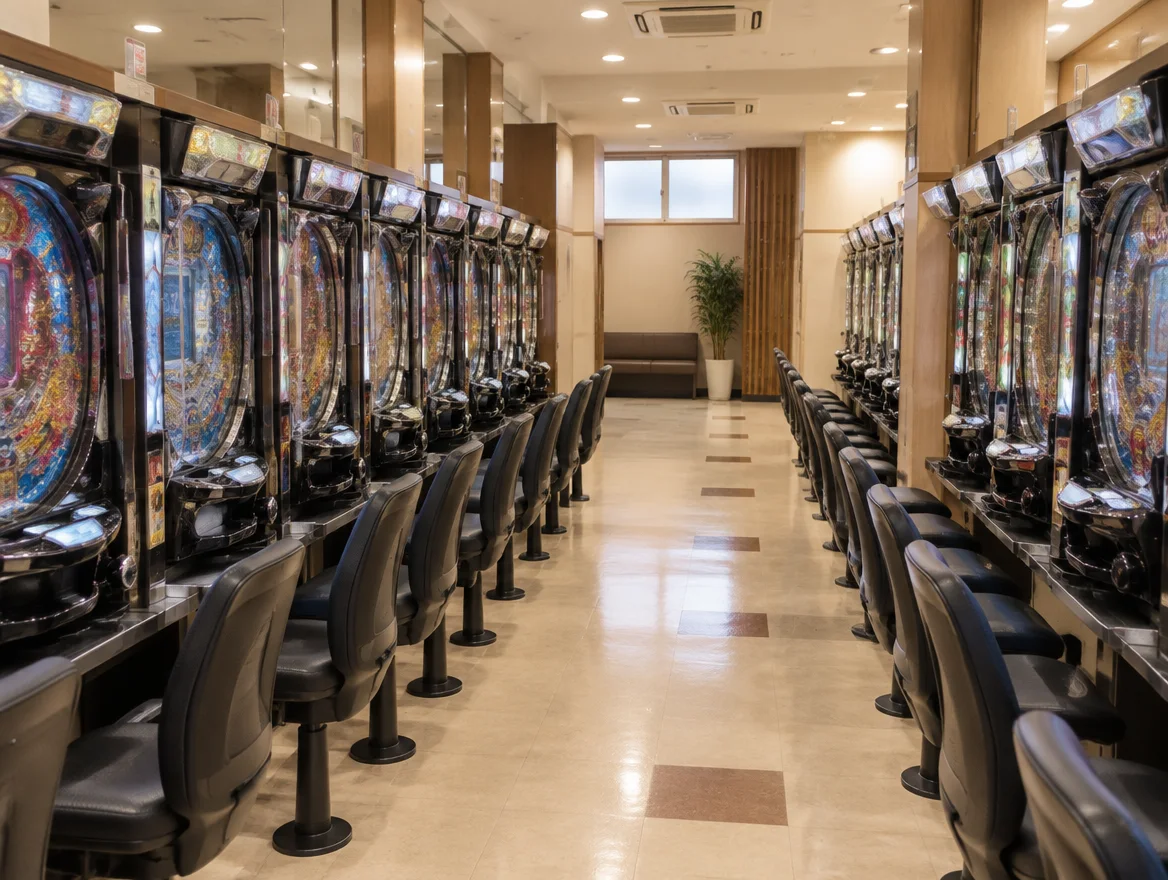
You’ve seen them in every Japanese city: buildings wrapped in neon, a wall of noise every time the automatic doors slide open, and rows of people facing glowing cabinets. That’s a pachinko parlour (also called a pachinko hall, or pachinko-ya). This page explains what’s actually going on inside, so the first time you walk in it feels like a game arcade rather than a mystery.
The short version
A pachinko parlour is a licensed adult amusement venue with two kinds of machines:
- Pachinko: an upright, pinball-like machine. You launch small steel balls into a board full of pins and try to land them in a pocket that starts a lottery on the screen (MARUHAN).
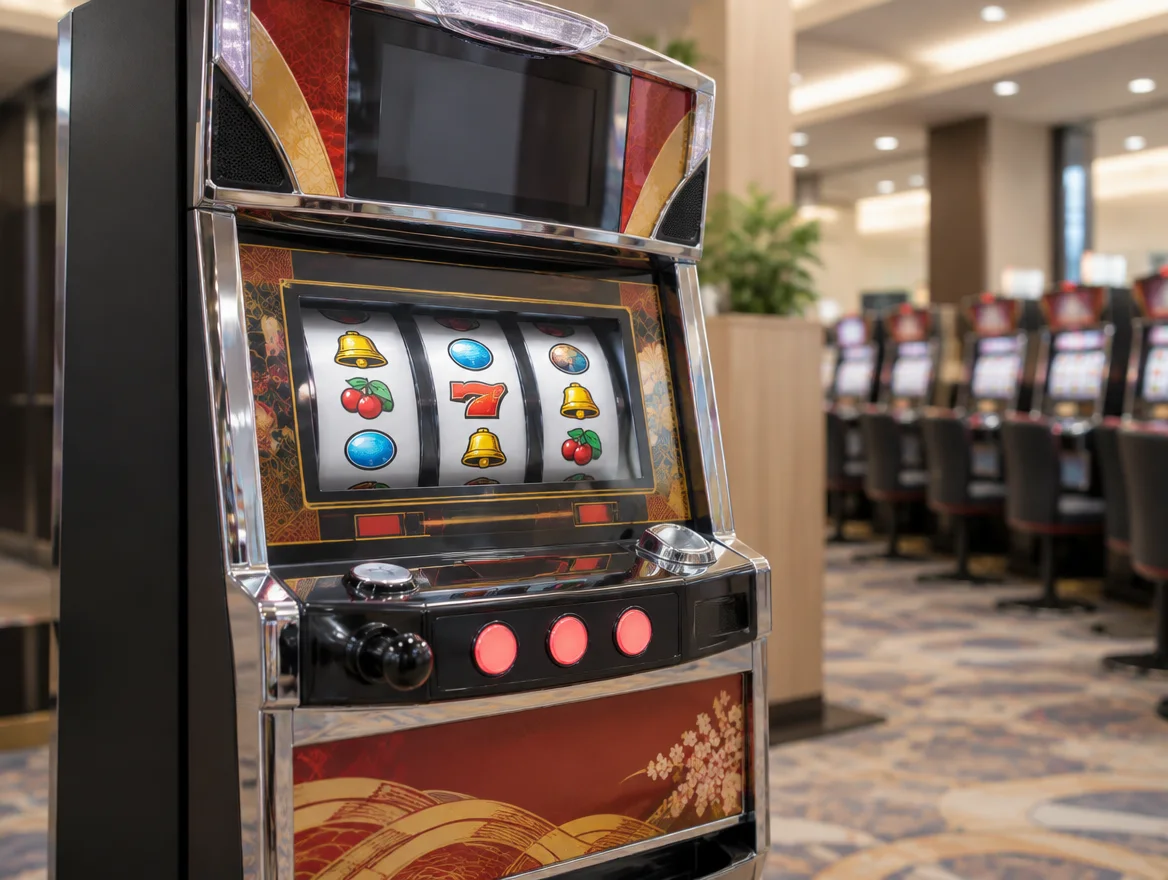
- Pachislot (パチスロ, also just “slot”): a three-reel machine played with medals or, on newer “smart” machines, electronic credits. You stop each reel yourself with buttons. See pachinko vs pachislot.
You rent balls or medals with cash at your machine, play, and swap whatever you end up with for prizes at a counter (DMM Pachitown). How those prizes can turn into cash is the famous “three-shop system”, explained in is pachinko gambling?
What happens inside, from the door to the exit
- You walk straight in. There’s normally no ticket desk or entrance fee. You must be 18 or over, and staff may ask for ID such as a passport (MARUHAN).
- Pachinko and pachislot are in separate areas. Look for signs like パチンコ / PACHINKO and スロット / SLOT. Within each area, different rows can have different prices per ball or medal, such as 4-yen and 1-yen pachinko (DMM).
- Every machine has a small cash unit beside it for renting balls or medals. It takes yen banknotes. For pachinko it’s usually on the left, for pachislot on the right (Pachinko Industry Web Reference).
- You play. Pachinko is mostly about steering balls with a handle and watching the screen. Pachislot is about pressing buttons. Full walkthroughs: pachinko and pachislot.
- You finish and count up. Your remaining balls or medals are counted (by staff or a counting unit) and recorded on a receipt or card.
- You visit the prize counter (景品カウンター). Prizes range from snacks and everyday goods to electronics and brand items (Pachinko Industry Web Reference). MARUHAN says its visitor halls stock Japanese souvenirs as prizes.
- You leave. Balls and medals never leave the building. Taking them out is not allowed (DMM).
Why it feels overwhelming (and why that’s normal)
In a 2023 street survey of 349 foreigners in Osaka, about 60% knew of pachinko and 40% wanted to try it, but only 2 people had actually played. And 321 of the 349 thought you could lose ¥50,000 or more in an hour (Global Pachinko survey via PachiSeven). The barrier is confusion and fear, not lack of interest. The noise, the Japanese-only screens and the fact that nobody explains anything all add up.
The good news: the basic routine is the same everywhere, and some halls now run visitor programmes with English help. See our parlour directory.
How parlours are regulated
Pachinko halls are licensed under Japan’s Act on Control and Improvement of Amusement Business (風営法, Fūeihō). Prefectural public safety commissions decide who gets a licence and where. The rules also cover operating hours, lighting, noise, advertising and which machines can be installed (Pachinko Industry Web Reference). Because each prefecture sets its own detailed rules, hours vary. The halls in our directory publish opening times of 10:00 and closing times between about 22:30 and 23:00.
Smoking: since 1 April 2020, indoor smoking has been banned in principle, with smoking allowed only in dedicated smoking rooms (AsGam). Halls may set aside part of the floor for heated-tobacco products under technical standards (Nichiyukyo Q&A). Older guides that say “smoking is allowed everywhere” are out of date.
A shrinking industry that wants new visitors
| Indicator | 1995 (peak) | 2019 | 2025 |
|---|---|---|---|
| Licensed halls | 18,244 | 9,639 | 6,464 |
| Players | 29.0 million | 8.9 million | 6.9 million (2024) |
Sources: P-Johojima (from the Leisure White Paper and NPA), WIGO (NPA, end-2025), Amusement Japan (2024 players).
Small halls are disappearing while mega-halls with 1,001+ machines are growing in number (WIGO). That’s one reason big chains and machine makers have started reaching out to overseas visitors.
A (very) short history
Pachinko grew out of wall machines imported from Europe. The first licensed pachinko parlour opened in Nagoya in 1930. Parlours were closed during the war, and in 1948 pachinko became a licensed activity under the new entertainment-business law. Entry for under-18s was banned in 1951, and the standard ball price reached 4 yen in 1978 (Global Pachinko history). That’s why “4-yen pachinko” is still the standard rate today.
What to read next
- New to all of it? Your first visit, step by step
- Worried about money? How much does pachinko cost?
- Ready to find a hall? Tokyo · Osaka · Kyoto
Quick answers
What is a pachinko parlour?
A pachinko parlour (pachinko hall) is a licensed amusement venue in Japan with rows of pachinko machines, which use small steel balls, and usually pachislot machines, which use reels and medals or electronic credits. You rent balls or medals with cash, play, and exchange what you have left for prizes at a counter.
Can tourists go into pachinko parlours?
Yes, if you're 18 or older. There's normally no entrance fee or reception desk. Staff may ask for ID such as a passport if you look young.
How many pachinko parlours are there in Japan?
The National Police Agency count was 6,464 licensed halls at the end of 2025, down 32.9% from 2019 and far below the 1995 peak of 18,244.
Are pachinko parlours open late?
The halls in our directory publish opening times of 10:00 and closing times between about 22:30 and 23:00. Prefectural rules set operating hours, so check each hall.
Sources
- MARUHAN – Let's Play Pachinko (what pachinko is, prizes, 18+ rule)
- Pachinko Industry Web Reference – Pachinko and the Law
- Pachinko Industry Web Reference – Playing Pachinko and Exchanging for Prizes
- DMM Pachitown – Pachinko beginner's guide
- WIGO – pachinko hall numbers at end-2025 (NPA data, Japanese)
- P-Johojima – hall count history (Japanese)
- Amusement Japan – Leisure White Paper 2025 (player numbers, Japanese)
- Global Pachinko – history of pachinko
- Nichiyukyo – Q&A on the revised Health Promotion Act for pachinko halls (Japanese)
- AsGam – Smoking rooms the new norm (indoor smoking ban, April 2020)
- PachiSeven – Global Pachinko survey of foreigners in Osaka (Japanese)
Facts on this page were last checked against these sources on 4 October 2026. Rules, prices and venues change, so always follow the signs and staff at the venue.